(also
known as customer response #32..."What do you mean 90
degree, 180 degree?")
The
1600 38mm (1 1/2") and the 2000 46mm (1 3/4")
carburetors each come in two styles. One is designed
for "90 degree nozzles" the other is designed for "180
degree nozzles". Whether or not the two types still
have the nozzle type that they left the factory with
is anybody's guess. Mechanics, car owners and parts
counter people don't always know the differences, and
the murky "official" parts book doesn't help much.
Originally the 65-67 1600 and the 67 and some 68
2000's came with the 90 degree nozzles. A lot of cars
have been altered.
The
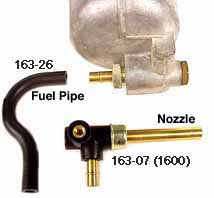
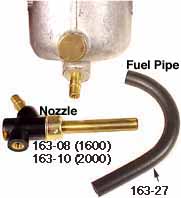
term "90 degree" or "180 degree" refers to the
relationship between the fuel pipe fitting on the
nozzle, and the threaded hole for the linkage screw.
If you turn your nozzle upside down you can see that
they are either directly across from each other (180)
or at a right angle to each other (90). You can also
just look at these pictures. The correct float bowl
for the 90 degree nozzle has a fuel outlet that points
horizontally at the throttle body portion of the
carburetor. The 180 degree type float bowl has a fuel
outlet that points downward at a 45 degree angle,
towards the air cleaner. (Your float bowl may or may
not have the drain plugs shown on the bowls
above.)
The
biggest problem with the SU carbs on the roadster
isn't the carbs themselves, it's what has been done to
them since they left the factory. Parts from both
types are mixed together and the result is something
that either doesn't work right, is prone to fire, or
both.
The
metering nozzle, the black plastic part you see go up
and down when you pull your choke, has to be able to
go up and down smoothly, and return completely with no
drag. When you lift the piston inside the carb up just
a tiny bit and let go, it should drop down with a
noticeable click or thump. It should sound the same
with the choke cable pulled or not pulled. If you pull
the choke cable, then push it in, you shouldn't be
able to touch the nozzle with your finger and have it
pop up the rest of the way, it should already be up.
If
the wrong nozzle is used for the particular
carburetor, the linkage piece that moves it will not
match and can lead to binding. If the fuel pipe has
been replaced with the wrong one, or by one out of
some other material, this can also lead to binding or
worse, fire. This small tube, is manufactured from
extremely high quality heat resistant neoprene, which
is not normal fuel line. It is also moulded so that it
has NO STRESS on it when it is installed. Granted, the
original moulded ones are relatively expensive, if you
don't figure in the costs of a possible fire. If you
are attempting to use a substitute type of line it has
to be out of a material that has a HIGH resistance to
hardening from the heat, and a HIGH resistance to
cracking from motion. If I had a nickel for everytime
someone brought a car to me after it had been
"professionally" tuned up only to find it was running
horribly because the choke stuck the next time it was
used due to stiff fuel pipes...
A
sticking nozzle can also be caused by a bent needle or
a metering nozzle that is not centered. (That's a
whole other subject!)
If
it was safe and workable to use 30 cents worth of
vacuum line, Nissan would have done it. It isn't, and
they didn't. When you get a fuel leak it goes right on
the exhaust manifold. I hate repairing burned
roadsters, and I hate having to buy one that can't be
repaired.
Fire
can also be a possibility due to improper length (or
missing) fuel overflow tubes. Basically you want your
fuel overflows that connect to the top of the float
bowls to run down below the exhaust manifold. You can
use the original long metal tubes or use the shorties
with a piece of fuel line attached and routed down
away from the exhaust.
What
we wanted to do with this page is at least show you
what float bowl goes with what fuel pipe and nozzle
type. From this you can determine if your car is a
hodgepodge of mismatched parts.
2000
90 Degree Nozzle Parts Situation...
The
90 degree nozzles for the 2000 come in a "front carb"
and a "rear carb" version. The 1600 90 degree nozzles
are the same front and back. One of the 2000 90 degree
nozzles is getting extremely difficult to find.
Usually you have to buy two of the one that is
available and have someone very careful and patient
unpin the brass shaft and reuse your old lower plastic
part. If this is the case the kit description will say
"To Modify Nozzles". If we have the F and R nozzles
the kit description will say so.