It
is extremely unusual to see a used top frame that does
not need some kind of work done to the front bow,
either minor or major. A number of reasons have
contributed to eventual problems with the front softop
bow on the 1968-70s. Primarily the front bow was a
weak design, like a big long hollow soda can. If it
had been made of a heavier guage metal it would have
survived much better. A secondary problem is that a
lot of owners never figured out the way to put the top
up with minimal strain on the front bow. Stress is
generated in the middle of the bow, eventually causing
it to collapse and or crack from fatigue. See
"How
to Put Your Frame Up".
Not using a center latch spacer (#4 above) also
increases stress on the middle of the front bow.
Symptoms of this condition start with a mild dent and
progress to a major dent, flattening, tearing of the
metal and eventually the bow breaks completely in
half. On top of this water condenses under the top
and/or leaks in and rust begins, both on the surface
of the bow and inside further weakening the structure.
Even moisture from fog or morning dew is enough to
surface rust the front bow since it lives under the
top material or the bow inner vinyl covering.
Any
frame that shows even the slightest dent or crack in
it should be taken apart by a body shop and a some
bracing installed. Then you would have a long lasting
solution. Even with a softop installed on a frame it
is eassy to run your fingers over the curved but
generally flat area above the windshield and feel
waves or "dents" which is the signal that failure is
coming. Actually EVERY frame; undamaged or not will
face this unless of course it is your top and you know
the frame has not been stressed improperly during the
raising of the top. The frames that already have more
damage need to be brought back to health by a body
shop or metalworker. Sometimes they need to use the
car as a guide as to how the curve should be. The
curve can change during the repair process so on any
repaired one you still may need to redo the curve of
the bow to match your windshield. Are you using the
factory spacer under the middle clamp? If not it will
NEVER seal no matter what you do and will be under
increased stress. The spacers are hard to find but
pretty easy to make.
The
rear hoops are typically in useable condition as they
are. If there is something unusual, i.e heavier than
typical surface rust, or a gleaming pristine surface,
it will be noted in the descriptions. Most of the
frames tend to have surface rust from condensation
under the two snap flaps on the center rear
bar.
With
ANY frame; you may encounter stripped threads in a
hole; or some other similar problem. Broken off
screws/bolts we can usually see and note; but we'd
have to actually restore one of these frames and
install it and a top on a car to be sure exactly WHAT
the condition is. All kinds of junk has been sold by
others (usually individuals; as "OK" or "GOOD") with
none of the above information forthcoming.
Click
on any blue part number to see picture(s) and
sometimes additional information on the particular
used frame. Hit the "BACK TO USED TOPS" link below.
FIT
NOTE
Any
of the "68-70" frames can be put on a 68-70 car and
will work just fine. There are differences between a
68 frame and a 69-70 frame which comes into play when
ordering a top or trying to mate up a separate front
bow with separate rear hoops. See the discussion on
top gutter styles and frame shape here
if interested.
The
softop frame is just that, the bare frame, order new
top material from the TOPS & TONNEAU'S
page.
The
top frame includes the front bow and the rear hoops.
The front bow is a big black hollow sheet metal piece.
The frame also includes the rear hoops.
The
frame does not include any items but those two.
OTHER
PARTS NEEDED
BESIDES BARE FRAME
Many
other parts are involved with the softop. In some
cases frames may be pictured with and/or described
with some of these items. If not mentioned or pictured
the frame DOES
NOT INCLUDE THEM.
Three
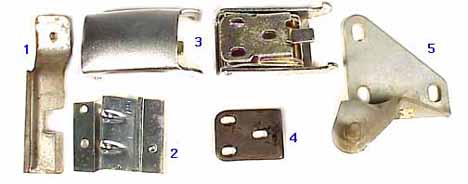
Latches to go on Front Bow (pic #3)
Three
Latch Receivers to go on W/shld frame; which also hold
visors and mirror. They are most likely on your
car.
Side
Top Supports (pic #5)
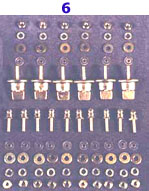
"Twistys
and Postys" (pic #6) There should be 6 twistys on the
back and side of the car and 10 postys on the sides
including the two up by the vent window for the
tonneau cover. These are only available new; on the
softop page in the NEW PARTS sections. The kit is
#999-97. Individual pieces are also listed on that
page.
Softop
Weatherstrip #977-02 listed on the W/strip page in the
NEW PARTS section.
And
of course the top material itself; with the windows
heat-sunk in. The softop material comes with the
necessary grommets for a professional auto upholsterer
to install to fit the top perfectly; but not the
aforementioned rear bar.
Optional
but nice to have are the side cables and the knife
blade attachment (pic #1) on the end of the cable and
the mating receiver for the cable-spring "knife blade"
(#2). (info below)
Spacer
that goes behind center top latch on front bow. (#4)
If ordering a top frame that already has latches on
it; or listing says latches are included HAS THIS
PIECE ALREADY.
Some
of these items can usually be purchased separately or
with the frame as needed as a new or used part. (see
numbered pics below and info in the text) We have
pictured some of them below. There are three front bow
to windshield frame latches (#3). Shown is the front
and back of the center latch, which has the
rectangular locating peg that projects out the right
center side of the picture. The side latches do not
have this peg. (Some hardtops were designed to use
these same latches, so check your hardtop, you may be
able to swap them instead of purchasing more if they
look like the ones below.)
On
each side of your car body behind the seats, only a
few inches from your seat tilt latches are part #2 and
#5. The #5 part is what holds your softop frame side
support bars, the main posts that hold up the frame.
These mounts are also used to hold most hardtops on
the car. The #2 part is the receptacle that the #1
part slides into. The #1 part is the softop cable end
bracket. The cars originally came with cables
(actually a long small diameter spring) that was
inside the top material around the side windows. The
spring cable acts like an elastic band, designed to
keep the top tighter against the window glass. These
cables were not available as a separate part; except
UGLY used ones if purchased with a frame. On one end
of the cable was a sheet metal "eye" that attached to
a screw on the sides of the front bow. On the other
end was #1, a knife-blade like bracket that you hand
push into the #2 clamp bracket. You pull down on part
#1 as hard as possible then shove it into the clamping
portion of part #2 to keep the cable tight. Universal
cable is sometimes available at upholstery supply
houses. The part shown as #4 is a spacer that goes
behind the center top latch. This isn't in the
original parts book, it may have been a solution
Nissan came up with to lessen stresses on the front
bow after the cars were sold; to help align the front
bow properly. These can be hard to find but you can
have a workable replacement fabricated fairly
easily.