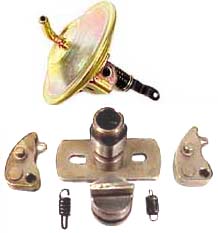
Even
though the cars are all 40+ years old and many states
that have emission programs don't inspect the old cars,
it may still be illegal to install this in your car.
USA
cars from 1968 -70 came equipped with a distributor
designed strictly to meet the emission control
requirements at idle. At pretty low mileage it became
apparent that the cars would have a hard time running and
surviving. When the "smog" distributors work correctly,
which usually isn't for long, the cars are doggy from
idle, and can be prone to overheating, rough idle and in
general strange running. When the smog-type distributors
get some miles on them you can many times add pinging,
stumbling, a bouncing idle (600 rpm now, 1600 rpm 2
seconds later etc or sluggish performance from start to
high rpm. And to make matters worse, the cars would begin
polluting worse.
Stock
type distributors are designed to be timed at TDC (0
degrees) and they have 35 degrees of advance built into
the centrifugal advance mechanism inside the distribtor.
Moving the timing ahead over TDC is dangerous as it can
lead to fried or broken pistons and rings from the
increase in total advance. The recurve kit converts the
distributor so it is equivalent to what the European and
Japanese cars came equipped with. This kit allows you to
set the timing at 16 BTDC (20 for Solex cars.) This gives
a more reasonable 31 degrees total advance, which is also
more suitable for today's gas and the likelihood of
milled cylinder heads, bored engines etc.
If
your timing advance settings throughout the rpm range are
not correct it is pointless to try to adjust your
carburetors as you are just compounding the problem. A
well tuned car, even with a "non-smog" distributor, will
be far more efficient, pleasant to drive, and will
probably have a lower smog output then your typical
untuned roadster with an incorrectly operating "smog"
distributor. This is my OPINION, I don't offer anything
as "FACT".
Remove
the 2 screws that hold the vacuum advance on the outside
of the distributor. Push down gently on the vacuum
advance so it's black lever that moves the point plate
inside the distributor will pop off. (You can also gently
pop this off with a screwdriver.) Remove the vacuum
advance unit. Take out the 2 screws holding the plate
that the points are attached to. and lift out the plate
that the points sit on. These are located near the
outside edge of the distributor, near the cap clamps.
Lift out the plate. You'll have to wiggle it as the
recessed tabs that the screws held down tend to be a
tight fit in their slot. You'll be able to look down
inside the distributor and see some numbers on the base
of the distributor cam near where the springs are
attached. If you see "17.5", you'll be a lot happier if
you change it. The kit we've used since gas went south
will say "7.5" . It is possible you'll see a 9, 11 or 12
also. Basically you take that number, double it, and
subtract it from 35 to get your maxium "initial advance."
(Depending on your particular engine situation that may
need to be reduced, or the advance curve lengthened to
make everything work properly)
If
your distributor has shaft or bushing wear or wear on the
distributor shaft weight pivot posts, you are better off
to go with a complete distributor.
If
you are still running your original air injection system
you can still recurve the distributor as the two parts of
the system are not interconnected.
The
#221-35 and #221-36 kits do not include the lower drive
tang that is included in the #221-10 and #221-24.

If
you have your old one you will probably be OK without a
new one. It's just nicer to change it; they are no longer
coming from Japan; so our pile is getting smaller.