More
information than you'll ever need to know...
A
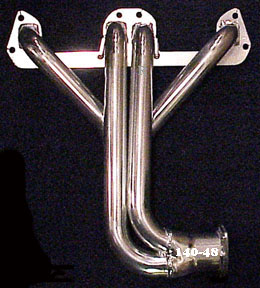
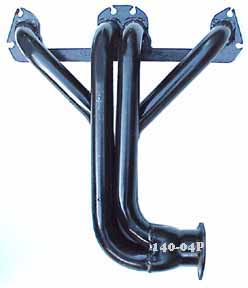
"header" is an aftermarket replacement for the
original exhaust manifold. Why do people use headers?
Usually it is due to the original manifold having been
designed with performance as a low priority. On many
engines a header can improve engine breathing
considerably. With the Datsun roadsters this is not
the case as Nissan went to GREAT lengths to make the
original manifold a quality item.
Then
why use a header on roadster? Price. If they were near
each other in price there wouldn't be a decision, but
they aren't. The manifolds are currently about 5 times
the cost of a header when WE CAN FIND THEM!
Although
the manifolds can be a bear to actually get out of the
engine compartment, once you get them near the engine
they fit like the cast and stamped part they are,
great. Headers, being a hand welded up product, do not
have the luxury of being as exact as a manifold. They
do fit, but it's not out of the question to have to
put a little dent here or grind this off there. Many
times you don't have to, but no header built out of
the required-for-performance size tubing fits all cars
alike. Look at how the factory dented up the original
manifolds and you'll see how tight clearances are.
On
the other hand, once you get a header away from the
head, it comes right out. Getting an original manifold
out of the engine compartment sometimes requires
raising the engine off of the left mount.
Access
to the mounting studs can also be more difficult. You
thought that was impossible right? Thankfully someone
invented flex sockets, "wiggle" sockets a,1/4 inch
drive socket sets, offset wrenches etc! Actually it's
the danged intake manifolds that create the problem.
As
headers go (and we've seen a lot of different roadster
ones over the years) these are designed extremely
well. Compared to headers of the past, these are
superb. A noted roadster enthusiast worked with the
original manufacturer of these headers over the years
to make them as good as possible and to minimize
installation difficulties that were sometimes so
prevalent with "old style" headers. Thanks Stan. It's
amazing the people that try to take credit for his
work.
We
offer these two ways, painted or with a high temp
coating
The
high temp coating (not paint) is nice in that it tends
to keep the heat in to keep the underhood temps down.
The header manufacturer has these plated by a
professional plating company that installs high tech
high temp coatings. Manufacturing and plating the
headers in bulk has made the price much more
affordable than the "old" days.
To
install the header you will also need to have the
original flange removed from your front exhaust pipe
and the adaptor for the header intalled (usually
welded) on to the pipe.
Starter
Interference... If
you have an original 1500 or 1600 starter on your car
you may find that the header either won't clear the
starter, or actually touches the starter when
installed. (Starters don't like heat) Even some of the
2000 starters won't work. The later version starters
are about 7" long from the tip of the most forward
part of the housing (when mounted) to the mounting
surface that touches the engine plate. If yours is
much longer you will need to replace the starter with
the correct one. Typically the problem occurs with
starters that are 7 3/4" and longer but it varies by
the header design. We usually keep lots of these in
stock. All of our starters will fit with the
headers.
Our
standard replacement starters (233-07) are a very
compact design; only about 6 inches long from mounting
flange to the far end.
We
want you to be happy and aware of what's what. We've
been taking this extra step for four years as
hobbyists and forty-two years as roadster business
owners and it's worked. Nobody likes to find out later
what they should have been told up front. These
headers have been altered and tweaked a couple of
times to ensure as trouble free an installation as
possible.
Making
It All Live Longer...Manifolds
had a brace that ran from the front of the manifold to
the engine mount bracket. This brace serves two
purposes. One is to lessen stress on the manifold that
is generated by the engine jumping around with the
exhaust system firmly mounted. With the brace in
place, the forces that are trying to bend the manifold
are reduced greatly because the leverage is reduced.
The brace also helps the manifold gasket to live
longer as the constant motion of the engine in
relationship to the exhaust system tends to eventually
crush the manifold gasket. Unless the manifold or
header is snugged down the gasket will eventually
fail.
Keeping
your engine properly tuned up will also increase
gasket and exhaust life. An engine that jumps around
at idle is very stressful on the exhaust system in
general, the manifold, the gasket, and even the engine
mounts.
Vibration...
The headers have no provision for such a brace but the
above described stresses can also be lessened by
installing a section of "flex" tubing just to the rear
of your front pipe's mounting flange. This is not the
lightweight low quality flex tubing popular in the
60's for "modificiations" it is a webbed tubing that
is used as original equipment many cars. Almost any
exhaust shop can fabricate this for you. We have them
here some of the time as well.